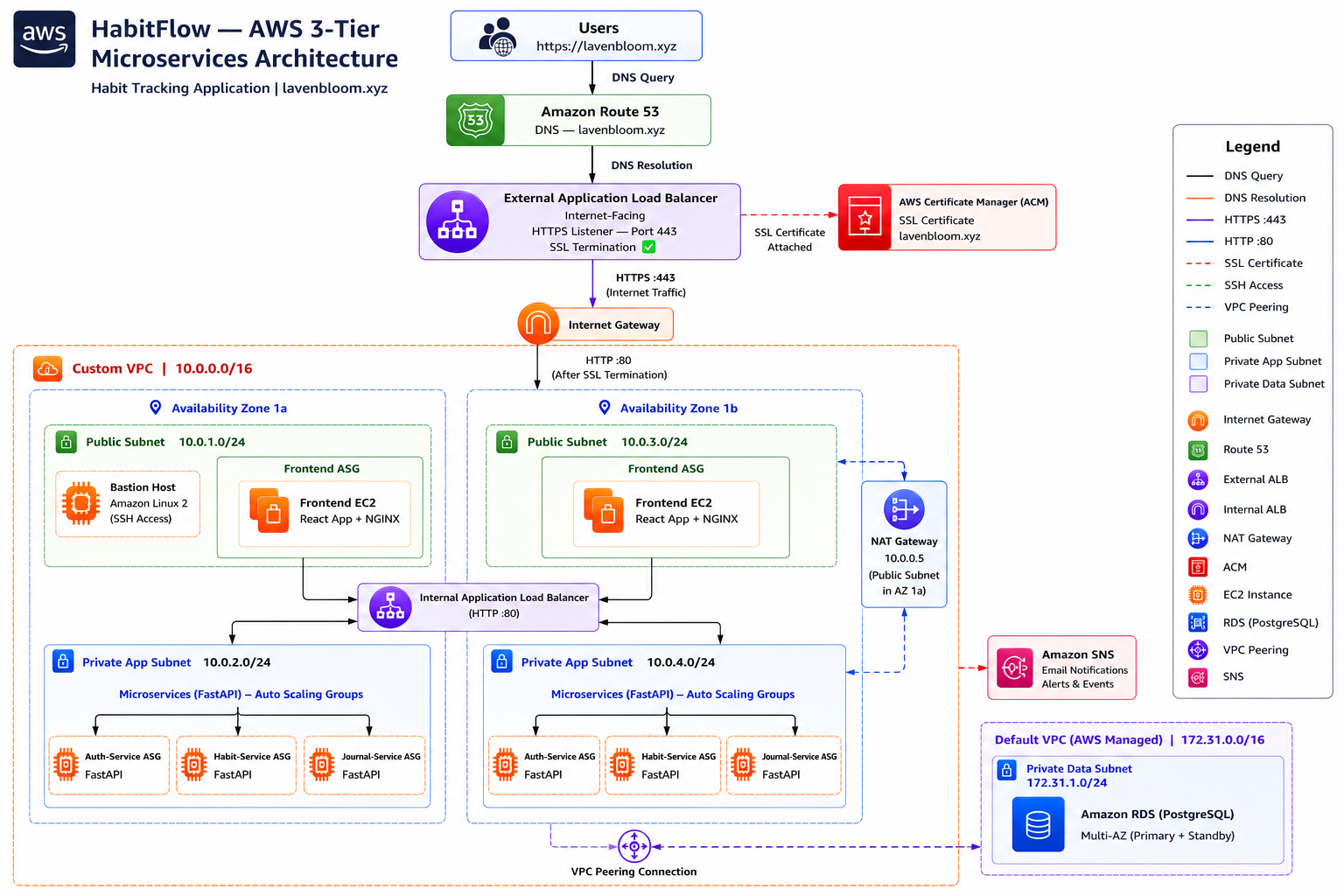
HabitFlow is a microservices-based application deployed on AWS using a 3-tier cloud architecture designed with multi-tier network isolation, independent microservice scaling, and centralized DNS and SSL management.
| Tier | Layer | Components |
|---|---|---|
| Tier 1 | Presentation | Frontend EC2 Auto Scaling Group |
| Tier 2 | Application | Auth, Habit, Journal microservices |
| Tier 3 | Data | Amazon RDS PostgreSQL |
Custom VPC CIDR: 10.0.0.0/16
| Availability Zone | Subnet Type | CIDR |
|---|---|---|
| us-east-1a | Public | 10.0.1.0/24 |
| us-east-1a | Private (App) | 10.0.2.0/24 |
| us-east-1b | Public | 10.0.3.0/24 |
| us-east-1b | Private (App) | 10.0.4.0/24 |
Users
  ↓
Route 53
  ↓
AWS WAF
  ↓
External Application Load Balancer (HTTPS :443)
  ↓
Frontend Instances (Public Subnets – Multi-AZ)
  ↓
Internal Application Load Balancer
  ↓  /auth        /habits        /journal
Auth Service   Habit Service  Journal Service
  ↓
Amazon RDS PostgreSQL (via VPC Peering)Admin → SSH → Bastion Host → SSH → Private InstancesAll backend services run in private subnets with no public IPs.
| Service | Responsibility | Deployment |
|---|---|---|
| Auth Service | Authentication & authorization | Dedicated ASG |
| Habit Service | Habit management operations | Dedicated ASG |
| Journal Service | Journal management operations | Dedicated ASG |
Routes frontend requests to the appropriate backend service:
/auth     → Auth Service
/habits   → Habit Service
/journal → Journal Service| Service | Purpose |
|---|---|
| Amazon Route 53 | Domain resolution → External ALB |
| AWS Certificate Manager | SSL certificate attached to External ALB |
SSL termination occurs at the External ALB. All public traffic uses HTTPS 443.
Attached to the External Load Balancer. Protections include:
Direct SSH to application instances is blocked. All admin access routes through the Bastion Host.
Each microservice scales independently via its own Auto Scaling Group, preventing a single service failure or traffic spike from impacting the entire platform.
| Component | Scaling |
|---|---|
| Frontend | Independent ASG |
| Auth Service | Independent ASG |
| Habit Service | Independent ASG |
| Journal Service | Independent ASG |
| Mechanism | Benefit |
|---|---|
| Multi-AZ deployment | Survives single AZ failure |
| Auto Scaling Groups | Elastic capacity per service |
| External + Internal ALB | Redundant load distribution |
| Distributed microservices | No single point of failure |
| Service | Purpose |
|---|---|
| VPC | Network isolation |
| Public Subnets | Internet-facing infrastructure |
| Private Subnets | Backend workloads |
| EC2 | Compute |
| Auto Scaling | Elastic capacity |
| External ALB | Public traffic distribution |
| Internal ALB | Internal service routing |
| NAT Gateway | Outbound connectivity for private instances |
| Bastion Host | Administrative SSH access |
| Route 53 | DNS |
| ACM | SSL certificate management |
| WAF | Web application firewall |
| RDS PostgreSQL | Managed relational database |
| VPC Peering | Cross-VPC database connectivity |
| SNS | Notifications and alerts |